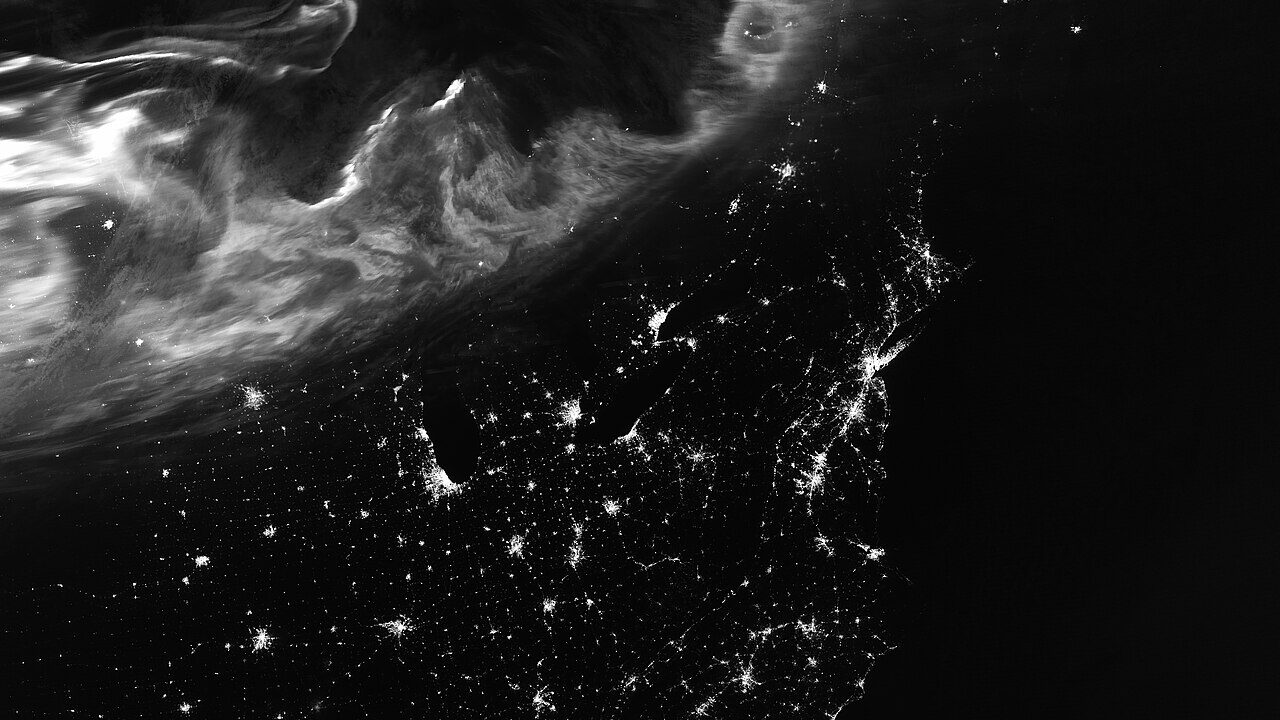
You cannot see a complete auroral oval from the ground, it is simply too large, a ring of light encircling a magnetic pole. A spacecraft can. NASA’s Astronomy Picture of the Day this week featured ultraviolet video from the SMILE spacecraft, a joint European and Chinese mission, showing a full auroral oval during the day, in a time-lapse covering about an hour in late July.
The images show how variable and turbulent auroras actually are: the oval breathes, brightens and ripples on timescales of minutes, driven by the solar wind pressing against Earth’s magnetosphere. Distant stars in the frame appear to drift only because the spacecraft’s view shifts as it orbits.
SMILE, the Solar wind Magnetosphere Ionosphere Link Explorer, exists to study exactly that interaction, how the Sun’s outflow of charged particles couples into the magnetic bubble that shields the planet. Understanding that coupling is how forecasters learn to protect astronauts, spacecraft and electrical grids from solar storms, which at their worst can damage satellites and induce currents in power networks on the ground.
The oval view is the mission’s signature measurement for a reason. Ground observers see auroras from inside, in fragments; a storm’s true scale and structure are only visible from outside and above, where the whole ring, and both its calm and its convulsions, fit in a single frame.
It is also, not incidentally, beautiful: a complete ring of ultraviolet fire around the pole of a planet, photographed by a robot, delivered as a picture of the day. Space science occasionally produces data so legible that no expertise is required to feel what it shows. This is one of those.
The timing flatters the mission’s purpose: the Sun is near the active phase of its cycle, when storms are frequent and the magnetosphere is regularly tested. A spacecraft built to watch the coupling between solar wind and Earth’s shield, arriving when the shield is busiest, is either lucky or well planned, and its scientists will accept either. Forecasters protecting power grids and satellite fleets will take the data in any case, beautiful or not.
US News Zone will continue to follow this research as further findings are published.
Related reading: Crops Face Many Stresses at Once, and Science Should Study Them That Way · Stanford Builds Lung Organoids With Their Own Resident Immune Cells · Ancient Bat Specimens Help Scientists Read a Rare Species' Present