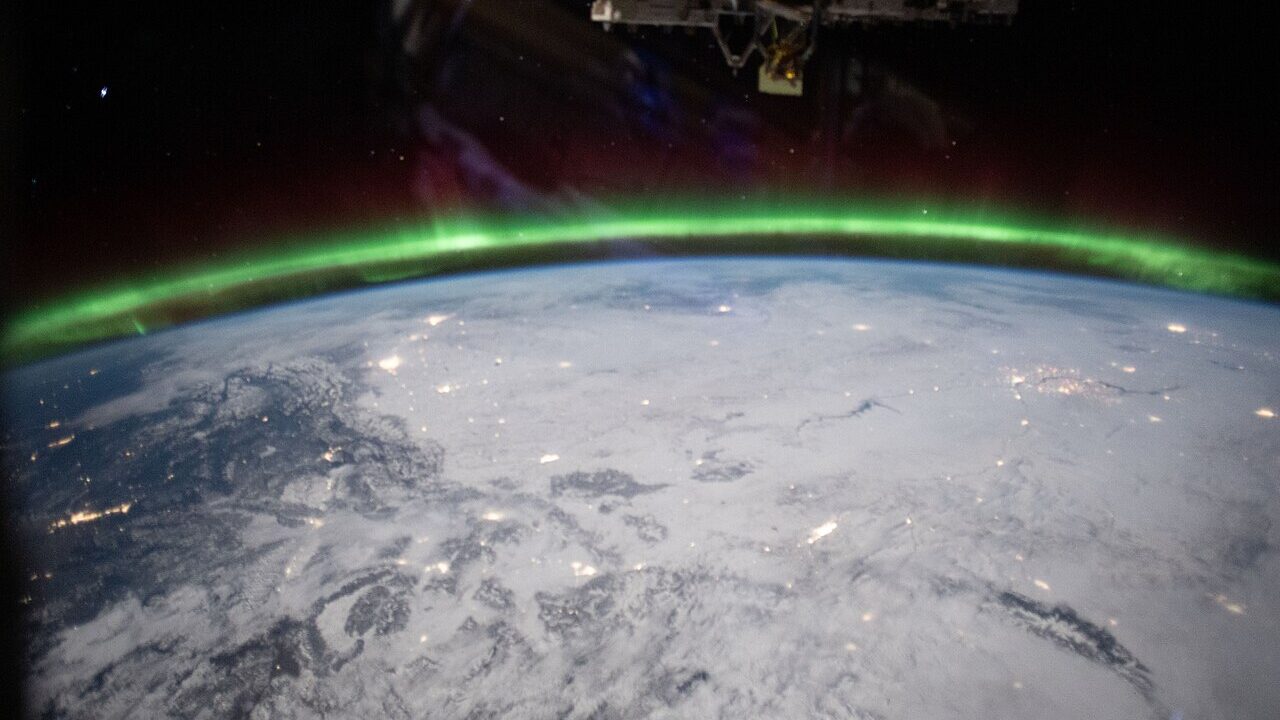
From the ground, an aurora is weather in the sky. From orbit, it is a system: a glowing oval encircling the pole, breathing with the solar wind, while thunderstorms flicker across the darkened continents below it. This time-lapse, filmed by an astronaut aboard the International Space Station during the 2026 Lyrid meteor shower period and published by the European Space Agency, compresses a night of that into a few minutes.
The science under the beauty is active this month. A European-Chinese spacecraft, SMILE, recently returned the first complete ultraviolet view of an auroral oval in daylight, and space-weather forecasters are watching a Sun near the busy phase of its cycle, when the storms that drive auroras, and occasionally trouble power grids and satellites, are most frequent.
The video below is from ESA Extras, the European Space Agency’s official extras channel, with footage credited to ESA and NASA. City lights, lightning and the green curtains of the aurora share the frame, a useful reminder that the space station’s crew watch the same planet’s weather from the other side of the window.
Video: ESA Extras (official YouTube channel). Embedded via YouTube; all rights remain with the channel. No footage has been downloaded or re-uploaded.
Related reading: Watch: Every CeeDee Lamb Catch From His 112-Yard Night Against Baltimore · Watch: The Final Outs as the Rays Complete Their Sweep of the Yankees · Watch: NASA's October Skywatching Guide, From Saturn to the Orionids